Posted by Karen Blakeman on 30th July 2007
First Exalead adds an option to limit your image search to faces, then Google, and now Live Search has joined the gang. In terms of ease of use, it is not as slick as Exalead’s but not quite as clunky as Google’s. You first of all carry out a search in Live Images and then add filter:face to your search search strategy or filter:portrait. If you want to look for black and white images you add filter:bw. At present you have to remember the commands but they say they are looking at how to make these features intuitively accessible through a drop-down menu or some other means.
On my image test searches on Live.com I cannot honestly say it was better or worse than Exalead or Google. None of them are perfect. They do remove most of the non-people images but all three also lose relevant faces and ‘portraits’.
Posted in Exalead, Google, Live.com, images | No Comments »
Posted by Karen Blakeman on 13th July 2007
Exalead has announced on its blog that it has reached an agreement with the Institute of Scientific and Technical Information (INIST) that will allow Exalead to offer its public search engine users access to INIST’s database of 13 million English, French, Spanish and Italian-language scientific articles. According to the press release “Exa-searchers will soon be able to explore this rich resource using Exalead’s practical search refinement tools, like dynamically generated lists of related terms and concepts”.
As a regular user of scientific databases myself, anything that highlights good quality, reliable and consistent resources is great news. I am becoming increasingly tired of explaining to people why I have problems with Google Scholar. I will delay my final verdict on the Exalead-INIST offering, though, until I have seen it in action.
Posted in Exalead | 1 Comment »
Posted by Karen Blakeman on 29th May 2007
Exalead have launched a video search for the YouTube, Dailymotion, Metacafe, Kewego and IFILM web sites. There is a link to the new beta service on the Exalead home page.
On the results page a pull-down box enables you to sort results by relevance, most recent, most rated, most viewed, or
length. You can also use the “Narrow your search” panel to refine your search by source (website) or video length. Below the “Narrow your search” panel is a tag cloud showing the the tags and categories of the videos appearing in your results, allowing you to refine your search further. Each entry in the results list includes a thumbnail image of the video, a title, summary, author, duration, upload date, and a viewer score represented by stars.
This video search option is different from the one that is offered to the right of the web search results page. The latter is the one to to go for if you want more serious, business items for example television news reports and interviews.
Posted in Exalead, Search Engines | 1 Comment »
Posted by Karen Blakeman on 5th May 2007
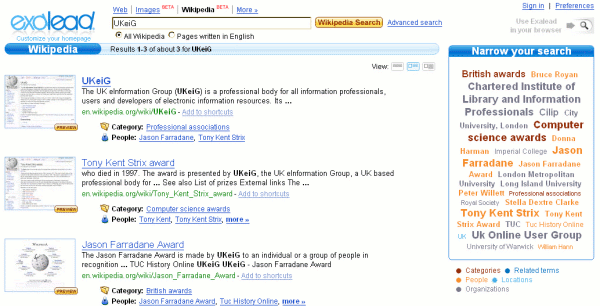
Exalead now has a UK version of its search engine that includes an option to limit your search to UK pages only. Both Exalead.com and UK have added a Wikipedia search and options to limit your results to blogs or forums. Alternatively, you can choose to exclude those types of sites. The Wikipedia search includes a “Narrow your search” panel on the results page that lists ‘tags’ for categories, related terms, people, location and organizations.

Exalead has also launched a new version of its image search with over one billion images indexed. The new ‘Face’ filter enables you to narrow your search results to images containing faces. It is not a hundred per cent accurate and sometimes excludes images that are of faces and includes some in which there are no faces at all, but it is close enough. Other options include size of image, wallpapers, image colour, layout and file type.
Posted in Exalead, Search Engines, images | 1 Comment »
Posted by Karen Blakeman on 23rd August 2006
A new version of Exalead (http://preview.exalead.com/search/), one of my favourite search engines, is currently in beta test. The beta home page thankfully remains minimalist and uncluttered but has retained the short cut options that enable you to add other sites and search engines to your own personalised version of the page. Exalead say that they will be increasing the size of the web database from 4 to 8 billion pages and there is a separate image search option on the home page.
The major changes are on the Advanced Search and the results screens. The Advanced Search has been simplified and the phonetic search and approximate spelling have gone. A pity …. er, no they are still there but under ‘What?’, ‘More’. For heaven’s sake, list them by default along with NEAR, Boolean search and the pattern matching/regular expression options! It was only when Phil Bradley mentioned their location in his blog that I realised they had not been axed. And if I missed the link, so will a lot of other people. If you have never tried ‘regular expression’, it is a pattern matching search that you can use to mask one or more letters in the middle of a word. For example the search /psych.*ist/ will find psychologist, psychiatrist, psychotherapist etc. You start and end the word with a forward slash, and a full stop followed by an asterisk stands in for one or more letters. I find it very useful when searching on chemical names.
The results screen has also been simplified. To limit your search by language, file type, location, RSS feed, video or audio you now have to click on ‘Refine your search’ on the right hand side of the screen. I think that is a mistake as I suspect that a lot of people will not bother to investigate it. Furthermore, because these options are not on the advanced search screen, they will think that Exalead’s search functionality is limited. I know some people find the current results screen overpowering and confusing, but Exalead could at least restore the RSS, Video and Audio buttons to the results page and include the refine options in Advanced Search as well.
A new feature that I do like is the page preview button on the thumbnails next to the results. If you have opted to display text only results there is preview link included in each entry. Preview enables you to look at Exalead’s own cached copy with your search terms highlighted. This has always been available but it has never been obvious how you do it.
As this is still in beta, changes are continually being made. Watch this space, as they say, for further developments. In the meantime you can compare and contrast at http://www.exalead.com/ and http://preview.exalead.com/search/
Posted in Exalead | No Comments »
Posted by Karen Blakeman on 2nd April 2006
Exalead has enhanced its NEAR command by allowing searchers to specify how close they want their search terms to be to one another. By default, NEAR looks for your terms within 16 words of one another in the order specified. You can now specify the maximum number of words that can separate your terms by using NEAR/n.
For example:
climate NEAR/2 change
finds climate followed by change but separated by up to 2 words.
climate NEAR/5 change
finds your terms separated by up to 5 words.
It is interesting that Exalead is resurrecting some of the search options that used to be standard but have been dropped by most of the major search engines. AltaVista used to have a NEAR command but this disappeared soon after it was bought by Yahoo.
Posted in Exalead | No Comments »
Posted by Karen Blakeman on 10th February 2006
Exalead is now searching over four billion Web pages and aims to reach eight billion by July. As many information professionals say, the size of the web database is irrelevant if it generates rubbish results but a critical mass is essential to encourage users to use a search engine, and Exalead has certainly done that now.
I am a great fan of Exalead: it has several unique features and has resurrected a couple that were discarded by the other main stream engines long ago. You can use wildcards (*) at the end of a word and the NEAR command looks for your terms within 16 words of each other. Unique features include phonetic and approximate spelling search options, and the pattern matching option enables you to cheat - ahem, I mean - can help you find that final, elusive solution for your crossword puzzle.
And if you want to run your search in other search tools after running it through Exalead, you can set up short cuts to them from Exalead’s home page. (For further details see Tales From the Terminal Room October 2005: Exalead revamps web search.
Posted in Exalead | No Comments »
Posted by Karen Blakeman on 19th September 2005
Exalead is the latest to join the desktop search club, with its preview launch of exalead one:desktop. This has been tested for several months by a selected group of users (I was one of them), but the non-disclosure agreement forbade us to mention that the software even existed! I can’t say that I have tested it exhaustively; I rarely need to use a desktop search program and Exalead’s does not yet index Thunderbird email or Star/Open Office documents. Support for these applications is promised for later in the year.
If your documents are mostly Microsoft, Adobe, html or Wordperfect then exalead one:desktop is worth considering for its unique advanced search options. As well as the standard phrase searching, OR and NOT commands there is a NEAR command which searches for words within 16 words of one another, a phonetic search, approximate spelling and pattern matching. You can also have word stemming switched on by default.
When you install the program, you can specify which directories and areas of your hard disk you want it to index and you can also control when it indexes. The results are displayed with preview thumbnails for some of the formats, but you can switch this off if you prefer to view the results as text only. On the left had side of the screen, there are options that enable you to narrow down your search by folder, author, date, size and document type. This will all be very familiar to users of the Exalead’s web search. For web search Exalead is the default but you can set up shortcuts to other tools.
Overall, definitely worth a try - especially for the advanced search features.
Link: http://www.exalead.com/
Posted in Desktop Search, Exalead | No Comments »